This blog is my contribution to the Curriculum in Science Symposium organised by Adam Boxer. Links for other posts are below.
With Ofsted announcing a focus on curriculum and nearly three quarters of secondary schools in England being free to make their own curriculum choices as academies, the ground for asking questions about curriculum is more fertile than ever.
In 2014, Gove declared: “I want every child to be able to go to a state school which excels, which nurtures their talents, which introduces them to the best that has been thought and written…”. The final phrase of this line is reminiscent of Matthew Arnold’s line (the title of this post) from his collection of essays, ‘Culture and Anarchy’ compiled in 1869. Critics immediately jumped on this: who is to judge what is the ‘best’? And when Gove put ‘dead white men’ firmly on the curriculum, uproar was inevitable. Ironically, as Peter Melville Logan points out in an essay on Arnold’s work, ‘the best which has been thought and said’ was quoted from a passage about the nature of critique; Arnold’s fundamental point was that acquiring culture is an ongoing process, and by extension, deciding what is ‘best’ comes only with knowledge of what is out there in the first place. In other words, you could argue that one is only in a position to debate whether ‘dead white men’ have a place in the curriculum once you yourself have studied ‘dead white men’. And if you studied them – presumably at school first – why should the next generation be denied that very same opportunity? Why should the next generation be excluded from a debate by withholding from them the knowledge they need to participate in it; stifled by ignorance?
No doubt I will have divided opinion in the above paragraph. This is precisely what makes dialogue about curriculum so fascinating, necessary and emotive, even. And this is why I am very excited to contribute to the Curriculum in Science Symposium, organised by the brilliant Adam Boxer. In this post, I shine a spotlight onto some of the philosophical underpinnings of curricular decisions. I proceed to offering filters that teachers can use to help them decide which content they should include and exclude from their science curriculum. Inevitably, these choices are biased with my values and philosophy. But importantly, this isn’t meant to prescriptive. Rather, it is illustrative of the decision-making process and serves to highlight the need to be aware of the assumptions that underpin each curricular decision. This post is specifically about a science curriculum. This specificity is necessary, since each discipline has its own paradigms, philosophies and quests for truth.
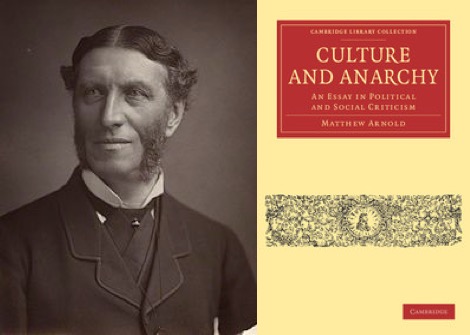
Matthew Arnold and his published collection of essays: Culture & Anarchy.
Status of Knowledge & Perception of Authority
Ruth Walker’s highly instructive contribution to the symposium started with the premise that the aim of the curriculum was for pupils to ‘have a rich, detailed, and well-organised schema’ in their long term memories. This statement leaves some questions unanswered: which knowledge does this schema consist of? Who should decide the knowledge that composes the schema? No doubt, these questions will be answered in various ways by different people, but which philosophical positions underpin these differences?
To get to the source of these answers, we must examine our strongly embedded philosophical beliefs about the status of knowledge in our minds. Presumably, science teachers will find little to disagree with when I say that we should teach the science that is the closest representation of ‘truth’: the theories which hold great explanatory power for a range of observations and generate empirically testable predictions. The knowledge-makers in this case are the scientists who discover and test their ideas about the ‘truth’. In choosing to teach this knowledge we elevate the authority of the scientists of today and those giants upon whose shoulders they stand. We dismiss the teaching of pseudoscience from the assumed authority of the scientific method. Thus, scientific knowledge has high status whilst religious belief and pseudoscience – in the science classroom, at least – does not. (NB: ‘school science’ assumes the philosophical stance that empirically evidenced ‘facts’ are ‘true’ – discussed further below).
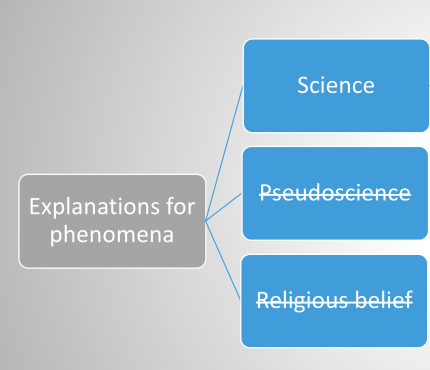
The authority of the scientific method leaves room for only empirically sound explanations on the science curriculum.
Whilst the holding of the knowledge-makers in high authority unites all science teachers (I’ve never met a science teacher who thinks science is nonsense), the authority of the teacher in the classroom divides opinion. This divide manifests itself in the classroom through the pedagogies that teachers choose to employ. A belief in the teacher as an authority will be revealed when the teacher unashamedly stands at the front and imparts their knowledge explicitly. They do not withhold lots of information from pupils in an attempt to get them to discover this knowledge themselves; they tell their pupils directly. Where this belief in teacher authority is not held, student discovery is likely to rule and the climax of the lesson will occur when the understanding clicks in the students’ minds, through the students’ own explanation of the clues presented to them.
How does this affect the curriculum? These two contrasting beliefs in teacher authority cause a fundamental shift in the focus of the curriculum, from a key goal being: students discovering the knowledge for themselves to build their own understanding to teachers explicitly imparting knowledge to pupils to build understanding and committing the knowledge to memory. Of course, there are many classrooms where a blend of the two is seen: a focus on discovery learning as the initial introduction of knowledge, followed by a focus on memory. But this betrays the belief of the teacher as the authority: the knowledge and the pupils’ relationship to that knowledge are held in highest regard, and not the teacher.
Of all of the ‘science’ out there, what should go into the curriculum?
Highly developed culture sets our species apart from the rest of the living world. The most remarkable feature of scientific culture is that it is both cumulative and evolving: we are constantly discovering the new, but equally able to go back and accept when we have been wrong. What makes science such a wonderful discipline to teach is that this is such a powerful and important paradigm for getting close to ‘truth’; different to other disciplines. The trajectory of our scientific understanding of the world as our culture evolved over thousands of years is mimicked somewhat in the minds of our pupils: as pupils’ scientific schemata develop, their vision of the world transforms and morphs. Magic and supernatural explanations are replaced* by cause and effect, by laws and principles. Scientists and the learned through the ages have had the opportunity to marvel at phenomena around them through the demystifying scientific lens, cultivating the paradoxically simultaneous feelings of curiosity and satisfaction. This, perhaps, is what many see as the purpose of a science curriculum: our pupils have the right to inherit this remarkable culture.
With this goal in mind, I think its helpful to divide scientific culture, or knowledge, into three categories: the substantive, disciplinary and the history of science.
Substantive knowledge includes all of the ‘facts’ and theories we have discovered and accept to be ‘true’: plants photosynthesise; waves transfer energy; atoms are rearranged during chemical reactions. How should we go about choosing the substantive knowledge to include? I’d suggest two factors for filtering the substantive knowledge: firstly, focussing on the knowledge with the greatest explanatory and predictive power^. This decision considers curricular time constraints and opportunity costs: Darwinian evolution is able to explain myriad observable phenomena, but knowledge of the symptoms of a particular plant disease stop just there, so my curriculum would prioritise the former. Knowledge of electron configurations, the periodic table and atomic stability of the group 1, 7 and 0 elements allows me to predict the reactivity of a plethora of substances common in laboratories, but detailed knowledge of the lanthanides offers limited predictive power. The former should therefore take priority.
The second filter of substantive knowledge is Hirschian in nature: it would prioritise imparting the scientific cultural capital which is required to participate well in society. By participating well, I do not mean being a responsible citizen alone, but being able to participate in high-level conversations and be able to access broadsheet newspapers. For example, knowledge of genes determining characteristics appear in many scientific and literary contexts so would have high instrumental value on my curriculum; I deem including such knowledge to be important. But this is also where I am in favour of a specification when it comes to GCSE and A-level: it defines this common knowledge.
Understanding the process by which scientific knowledge is created – the scientific method – and the philosophical assumptions upon which it is based, comprises disciplinary knowledge. Such knowledge includes, for example, teaching pupils that scientific models change over time as new evidence is gathered, and that empirical data is used to influence scientists’ thinking. This philosophy of science has to be limited to one stance: that scientists take theories with sufficient empirical backing as ‘truth’ in order to progress. Defining ‘truth’ and debating the process of inductive reasoning is beyond the scope of ‘school level science‘. Disciplinary knowledge also includes various aspects of the scientific method: variables in investigations, qualifying the validity of results through their reliability, accuracy and uncertainty etc. They help pupils understand how and why the substantive knowledge was accepted as ‘truth’ in the first place. It gives pupils an appreciation of the possibility of the truth status of the substantive changing, qualified by the robustness of the evidence that it rests upon. I do not thinks pupils doing school science are in a position to make their own conclusions about established facts – they are not ‘being scientists’ and creating new knowledge. However, through evaluating the certainty of conclusions in experiments they conduct, they are familiarising themselves with the disciplinary knowledge of school science and reproducing established facts.
The history of science is an important body of substantive knowledge, but consists of ideas previously, not currently, held to be true. What sets it apart from other substantive knowledge then, is that its status of truth has changed. Categorising this distinctly from other substantive knowledge serves to assist with curriculum planning. This is because its teaching in the school science classroom also serves another purpose: to bring alive with narrative and examples, the disciplinary knowledge of science. It illustrates how ideas change over time, which makes abstract aspects of the disciplinary knowledge far more concrete. For example, being aware of the historical models of the atom and the experiments that yielded evidence that resulted in new models, exemplifies the idea of getting closer to the ‘truth’. Furthermore, knowing the major players of the scientific truths of the past, and being familiar with their works and experiments is important cultural capital. Unfortunately, the power of this hinterland knowledge is somewhat underestimated, as evident in its sparsity in curricula today.

Science knowledge is composed of (green): the substantive – which includes our knowledge of the accepted truth; disciplinary – which includes the knowledge of the processes that allow us to discover and test the truth; and the history of science – knowledge that was once believed to be true. Orange: the reasons for including them in the curriculum.
An essential part of delivering the substantive, disciplinary, and in some cases, the history of science knowledge involves carrying out practicals. This exciting, experiential dimension of the scientific discipline brings a tacit appreciation of science that makes it a unique subject. I want my pupils to have these memorable experiences: of dissecting a heart; building a circuit and experiencing the beauty of the colourful flame tests. Whilst these practicals serve to strengthen the retention of the scientific concepts they each demonstrate (if used after the theory has been taught), the very memory of these experiences is worthy in and of itself~.
Finally, there are two instrumental factors that affect decisions about curriculum content that are important to consider. Firstly, as citizens we all have a duty to understand and interact with our environment with a sense of responsibility and sustainability. An appreciation of this requires that ideas such as climate change, deforestation and conservation hold a place in the curriculum. Secondly, it is undeniable that pupils leaving school should have been taught well enough to gain strong qualifications. It would be unjust to exclude content that was on the exam specification simply because the curriculum designers adhered strictly to the filters described above. Strong qualifications are a passport for future study and success.
As long as we are aware of the curricular decisions we make, and think about the goals these decisions help to serve, then we are doing what we perceive is right for our students. If we are clear about the ramifications of our choices, then it can be said we are doing the very best for our pupils. In this sense, knowledge about curriculum and choices is power. This is what makes this curriculum symposium so exciting: it forces us to question our curricular choices by empowering us with knowledge about different curricular dimensions. And armed with the right questions, we can seek to make well-informed decisions.
Footnotes:
*Perhaps naive misconceptions are not replaced, per say, but as teachers we can try to help the more correct truths persist, by working around them, as Gethyn describes in his contribution, here.
^Could the Big Ideas have the greatest explanatory power and be the basis for filtering the substantive content? Jasper Green explores this in his contribution, here.
~Practicals also help pupils grasp rudimentary skills of measurement, and give a sense of accuracy, for example. Tim Oates discusses the role of practicals in science in his contribution here.
 Bunsen Blue
Pingback: Directory of Curriculum Blogs, Books and Articles
Pingback: Designing a new SKE curriculum – docendo discimus
Pingback: Building a memorable curriculum – Kaye Chem Notebook
Pingback: Curriculum in Science: A Symposium – A Chemical Orthodoxy
Reblogged this on The Echo Chamber.
LikeLike
Pingback: Curriculum Links Part 1: Underlying Principles – CogSciSci