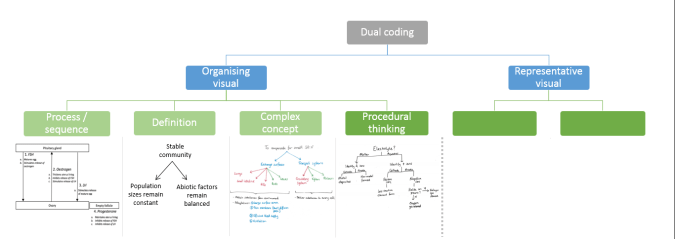
Effective teacher explanations are integral to teacher-led lessons. Clear explanations are best delivered when teachers begin with concrete examples before sharing abstract and generalised ideas. Clear diagrams also help teachers to effectively communicate their ideas. Diagrams elucidate the relationships in a sequence. Diagrams can also make definitions memorable and complex ideas easier to follow. All of these diagrams help explain declarative knowledge: the factual knowledge of our disciplines and the links between them.
But our curriculum is also filled with procedural knowledge; the knowledge of how to answer a particular question or perform a particular task. In science the most obvious manifestation of this is in equations which I have written about in great detail here and here.
Unfortunately, I have seen some terrible dual coding of maths procedures where teachers have drawn symbols to represent each step of a procedure! This is counterproductive because pupils are interpreting a step they need to do AND a symbol for it! In general, pupils learn procedures through practise, not dual coding. With a few exceptions, the best way to teach procedures is through lots of worked examples and NOT dual coding.
The temptation to make a pretty worksheet with lots of visuals may be strong, especially when we see ‘dual coding’ is everywhere – the ‘in’ thing. But it is not as effective a use of your time as a teacher as planning lots of worked examples where you create step-by-step models of how to perform the procedure. If you create a symbol for every step of a procedure you are doubling the amount of information the pupil has to process because symbols are not intuitively helpful for procedures: you have to learn to interpret what they mean. What use is a symbol if it creates additional cognitive load for pupils?
Organising visual 4: procedural thinking
There are a few occasions where dual coding IS useful: if the required procedural knowledge is a series of decisions. In this case, it is incredibly helpful to make this thinking framework explicit by drawing a decision tree.
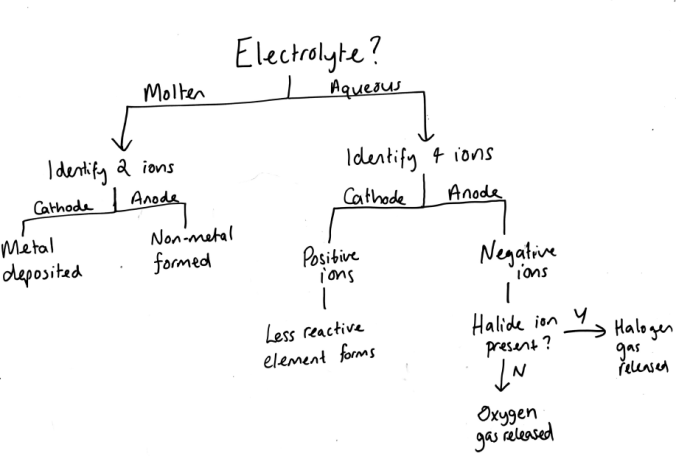
Electrolysis: In this example, I have sketched out exactly how pupils should think when they have to work out the products of electrolysis of any ionic compound. Each branch is a decision they must make.
This physics example is taken from Ruth Walker’s blog, which is full of more incredible organising visuals.

Decision trees help make a thinking framework explicit.
The second case where dual coding for procedural knowledge is useful is when you would expect pupils to draw a diagram to help them answer a question. For example, using a number line to identify what state a substance is at a given temperature:

Pupils draw the number line and follow the steps to work out answers to questions such as: ‘Given that sodium has a melting point of 98 degrees Celsius and a boiling point of 883 degrees Celsius, what state would it be at 56 degrees?
Finally, practical methods can be taught using diagrams, which are explored in the next post.
How to use in the classroom
If pupils understand these visuals for procedures, they will be able to reach the correct answer given any problem on the topic. Paradoxically, practising drawing the visual isn’t always the best way to learn it. For example, pupils do not need to practice recalling decision trees to master them. But drawing a number line *is* helpful to help work out the state of a substance given its melting and boiling points.
To truly learn the procedure, as in the case of electrolysis, pupils need to apply it. So, you need to model its use and pupils need to practise using the visual with lots of questions to reach fluency. This is the best way to internalise the procedures, rather than explicitly self-quiz on the diagram. In short, diagrams for procedures are best used through application, not regurgitation.
Chunking the steps of the procedure is best. E.g. give pupils lots of electrolysis questions but for each question pupils should only make the first decision on the tree: to decide whether the electrolyte is molten or aqueous. This will expose them to a variety of cues they may need to make this decision. E.g. looking out for state symbols – (aq) vs (l) – or the words ‘dissolved’ vs. ‘molten’ or ‘heated until liquid’. Then repeat for each step, and after each round of practice have an explicit discussion with pupils about the variation in the questions which all form cues for them to make that particular decision.
That concludes the use of organising visuals – diagrams that help organise a complex web of ideas to help pupils visualise their structure.
My next post will be about diagrams representing the physical world faithfully, and then as a model.
 Bunsen Blue
Pingback: Clear Teacher Explanations 2d: Faithful Diagrams | Bunsen Blue
Pingback: Clear Teacher Explanations I: examples & non-examples | Bunsen Blue