Analogies & models are excellent tools for delivering clear teacher explanations when used judiciously. Diagrams can prove very useful at explaining the different parts of the analogy and how they map onto the knowledge they represent.

Some models act as lenses through which pupils can appreciate the same idea from different perspectives. For example, in chemistry, ideas are constantly flitting between visuals of the real world (fizzing, colour change, shiny metal), particle diagrams (depicting atoms and bonds) and chemical formula. Each of these is a different way of representing the same thing. They are formally known as the macroscopic, microscopic and symbolic lenses through which the world can be described (see Johnstone’s triangle).
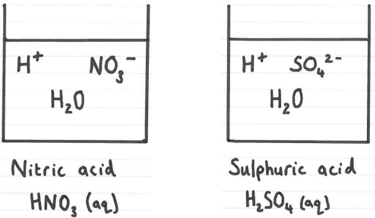
It can be helpful to visualise this: pupils cannot see what a chemical looks like in solution; make it visible for them. E.g. nitric acid (HNO) separates into Hand NOions in solution.
Other models help pupils navigate a new idea by comparing it to something more familiar. For example I often discuss limiting factors of photosynthesis as being akin to there being limiting ingredients or ovens in a cake-making factory. This works well because it is easy to grasp the idea that you can have lots of ovens but only a little bit of flour: the amount of flour puts a limit on the number of cakes that can be made. Similarly, even if a plant has lots of chlorophyll, if there is not enough light, not all of the chlorophyll will be used. This makes light the limiting factor in the amount of sugar the plant is able to make during photosynthesis.
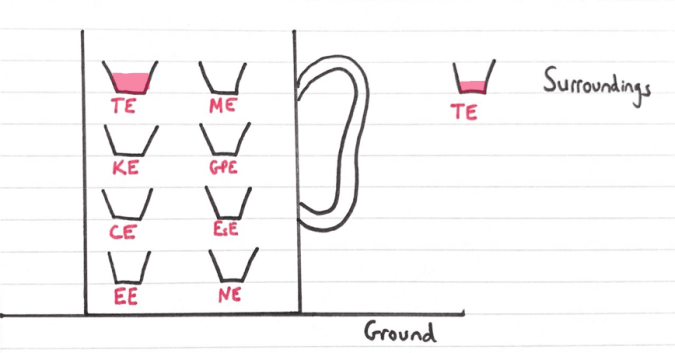
Other models make an abstract idea more concrete. For example, energy stores in physics can be represented as buckets of energy. Without this concrete model, imagining something as abstract as energy is very difficult. The idea of buckets gives my pupils something physical to actually think about. I always use the following diagram when introducing the idea of energy stores. This hot mug of tea has energy in its thermal energy store. If I add sugar, then the tea would have energy in its chemical energy store too. As the tea cools down energy will be transferred from the thermal energy store of the mug & tea to the thermal energy store of the surroundings.
How to use in the classroom
Explicit teaching of models is all about making it absolutely clear what the model represents, one step at a time, and also making it clear which parts transfer to the real thing and which do not.
Use your visualiser (or whiteboard) to show the diagram and point to the different parts of the model to post questions as you explain. For example:
Teacher: “Although we use the word ‘energy’ in lots of different ways, there is only one type energy. Scientists say the energy can be in different ‘stores’. For example, this hot mug of tea has lots of energy it it’s thermal energy store. Thermal is to do with heat so a hotter object will have more energy in it’s thermal energy store. This mug has more energy in its thermal energy store than a cube of ice. [Compare diagram shown to that of an ice cube with less energy in the thermal energy store]. Notice that I am not saying that hot objects have more thermal energy. I am saying they have more energy in their thermal energy store because there is only one type of energy: thermal energy is not different to any other ‘energy’. We will ignore the other stores for now. So, how many types of energy are there? 1…2…3…”
Class in unison: One!
Teacher: Which is correct: there are different types of energy or different stores of energy? Types or stores?
Class in unison: Stores!
Teacher: Which energy store is relevant when we are talking about how hot an object is? The __[hums]__ energy store. Say all three words, together on three… 1…2…3!
Class in unison: Thermal energy store!
Teacher: Excellent! So, let’s focus on the language now. Hotter objects have more energy in their thermal energy store. Always say the three words together: adjective energy store. So, in a full sentence, who can compare the energy of the mug to the energy in the ice cube? You need to say: ‘The X has more energy in its X energy store than the X’. Tell the person sitting next to you – go! [Pause]… Three, two, one, hands up! [Scans room]… Tom.
Tom: The hot mug of tea has more energy in its thermal energy than the ice cube, sir.
Teacher: Oooh almost! You were so close. Remember, there are always three words that go together, but you said only two: thermal energy. Which words did you miss out? Say it all again.
etc…
Continuously reference the real-life example and link it explicitly to the model. “The buckets I have drawn refer to energy stores. Do not call them buckets in the exam!” The language is vital for pupils to get write whenever using a model or an analogy. The greatest risk is that pupils misapply the language of the analogy itself to the idea it’s representing.
Analogies and models also have another pitfall: there will be aspects of the analogy that do not apply to the idea you are trying to convey. You should make these explicit. For example, all objects contain energy in their thermal energy store, so drawing an empty bucket is flawed. The buckets are relative. However, you might want to consider when and whether you evaluate such limitations: often such a discussion early on might make the idea more confusing. Use your judgement.
Do not ask pupils to guess how they think different parts of a model link to the real world. This will obscure the clarity of your explanation. Tell them explicitly. Furthermore, playing ‘guess what’s in my head’ is most likely to favour the advantaged pupils in your class – the ones who already have lots of background knowledge. They mislead you if you then think the whole class ‘gets’ it and consequently prevent you from making links between the model and idea explicit.
Next post concludes Part 2 of #ClearTeacherExplanations: how NOT to dual code. I’ll share common pitfalls to avoid dual coding from becoming a fad.
 Bunsen Blue
Hi Pritesh, Loving this series. I am wondering how your use of clear explanations meshes with your usage of self written textbooks. When do you choose rely on the text and diagrams you have prepared for the books, and when do you choose to model other things live with a visualiser? Or has it evolved to always being both?
LikeLike
Pingback: Clear Teacher Explanations I: examples & non-examples | Bunsen Blue