Are your pupils more polite at the end of Year 7 compared to the start of Year 7? Do pupils in Year 8 work harder than pupils in Year 7 because their habits of working have improved over their time at school? Are your pupils in Year 11 better at taking responsibility for their actions than when they were in Year 10?
These questions about character development fascinate me because they go directly to the heart of school improvement – beyond data, spreadsheets, & targets. In addition to being places where pupils acquire excellent knowledge, I believe schools have a significant role to play in making pupils better people.
School walls are often plastered with ambitious words relating to pupil character. Your school motto and values might refer to ‘hard work’, ‘responsibility’, ‘respect’, ‘gratitude’ and ‘honesty’. But to what extent do your pupils change to embody these values better as each year passes?
This post is about the roadmap to improving pupil character: how can we help our pupils become better versions of themselves? It goes hand in hand with my previous post: Building Culture: how to shape character through daily interactions.
Do you agree with the following premises?
- It is better to be more polite; to take more responsibility for your actions; to be grateful rather than entitled; to work hard rather than be lazy & to think about others rather than just yourself.
- Some people are more polite than others; some people are better at taking responsibility for their actions than others; some people are more grateful than others; some people work harder than others; some people are better than others at thinking about how their actions affect those around them.
- It is possible for individuals to become more polite, more responsible, more grateful, more hard-working and more dutiful.
The first premise relates to shared morals and values. For example, you cannot help pupils become more grateful if you do not think that an attitude of entitlement is both unhelpful and undesirable. Gratitude is better than entitlement. Hard work is better than laziness. Having clarity about what you value as a teacher and as a school is the most fundamental core from which your conviction to act will follow. Without conviction, you cannot instil values in your pupils effectively.
The second premise relates to believing that not everyone is the same. To see that some pupils are more polite than others, for example, requires objective criteria by which to evaluate politeness. This requires a school to have a shared set of norms for what politeness is. For example, you may believe that pupils who say ‘Good morning, sir’ every time they pass you in the corridor or on their way into your classroom, say ‘please’ whenever they make a request, and who say ‘thank you for the lesson, sir’ when they leave your lesson are more polite than pupils who do not behave in this way.
The third premise is about believing these character traits can be changed. Entitlement and impoliteness are not immutable characteristics, but rather, emerge from a collection of habits. New and better habits can be taught, practiced and embedded. You can teach pupils to be more polite, more grateful, more hard-working and more responsible. To paraphrase Aristotle, excellence emerges from habits. Virtues are not innate; they are taught and refined.
Aristotle is specifically saying that we can change character by changing habits.
“Excellence is an art won by training and habituation. We do not act rightly because we have virtue or excellence, but rather we have those because we have acted rightly. Excellence, then, is not an act but a habit.” ~Aristotle
If you agree with these premises, then the path to helping pupils becoming better people is illuminated: we need to have granular clarity about the behaviours we want to make habitual in our pupils. The act of repeating these behaviours will help our pupils become better people.
So the questions to follow are:
- What behaviours do we want to make habitual in our pupils?
- How do we teach these behaviours to our pupils?
- How do we reinforce these behaviours so that the behaviours become habitual.
All of this needs to be considered in addition to building buy-in from pupils. This partly comes from explaining to pupils why these behaviours are desirable. We need to inspire the pupils to act virtuously. However, anyone who has worked in a school knows that one inspiring assembly or a rousing speech to a class is not sufficient at ensuring every pupil acts this way habitually. We also need to cultivate the conditions where behaving in this way becomes easier, more likely, and the expected norm.
Extrinsic Rewards vs Intrinsic Motivation
I used to believe that extrinsic motivators such as using praise, merits, stickers and certificates were at odds with intrinsic motivation. Intrinsic motivation was, in my mind, a mysterious driving force of moral or virtuous behaviour that comes from within. I now believe that far from being dichotomous, extrinsic rewards pave the road to creating intrinsic motivation.
Rewards and sanctions are remarkably effective at forging new habits. Holding pupils to account for bringing all of their equipment to school might begin with them remembering to pack to their bags the night before because they want to avoid an after-school detention. But over time, they may be more motivated by the praise they receive for being so well-prepared. “Josh, you are so much more organised, now. You take responsibility for packing your bag – well done!” As they mature still, they may be primarily motivated knowing that taking responsibility is helping them to have a better future: being organised is important for success after all. But ultimately, we aspire for our pupils to be responsible because it is simply a part of who they are. Being responsible has become a part of their identity. This shift in motivation over time from extrinsic to intrinsic is encapsulated by the pyramid shown below.
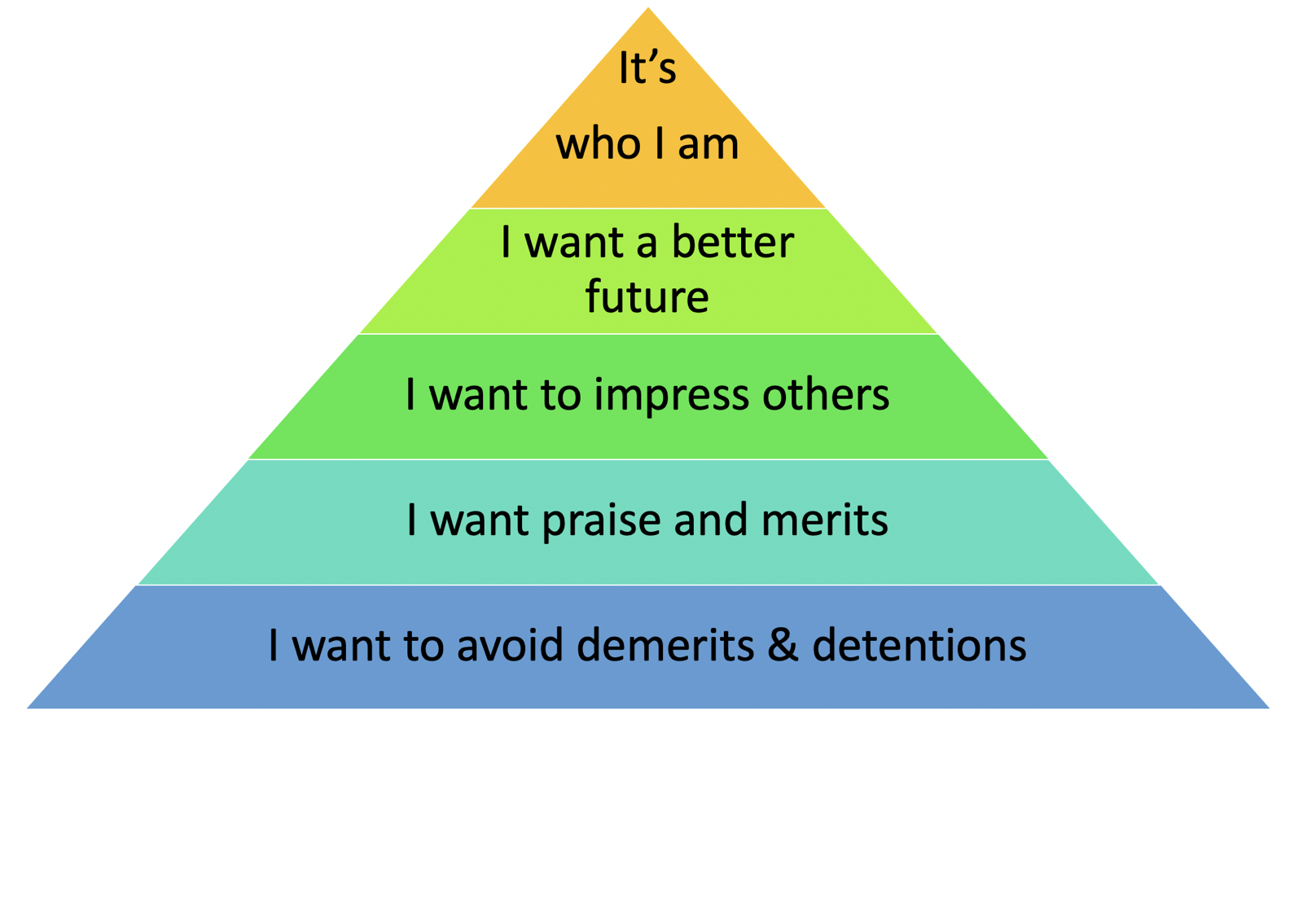
In this way, extrinsic motivators are the necessary crutches that help forge the habits that lead to pupils being intrinsically motivated. “If you are somebody who takes responsibility for being organised, regardless of whether anyone checks your equipment, you are at the top of the pyramid. Being responsible and organised is who you are”, is the kind of narration I might use with my pupils.
For each behaviour and each value, pupils might be on a different place on the pyramid:
| Value | Behaviour – specific behaviours that demonstrate the value |
| Responsibility | Arriving to school in correct & tidy uniform. Arriving to school with all equipment & homework. Accepting responsibility for misbehaviour and apologising. Cleans up own table after lunch. |
| Gratitude | Says ‘Thank you, sir’ at the end of every lesson. Writes postcards to show appreciation to teachers. Puts hands up to contribute every time a question is asked in lessons they can answer. |
| Hard work | Completes classwork to a high standard. Contributes to lessons throughout – no coasting. Completes homework and extension work. |
Our goals as teachers is to help our pupils move up the pyramid for each trait. How do we move pupils up?
- Be clear what your values are.
- Have granular clarity about the behaviours that demonstrate these values & ensure all staff know them.
- Teach the behaviours to pupils explicitly.
- Give pupils LOTS of opportunities to demonstrate these behaviours. The more opportunities they have the more likely the behaviours will become habitual.
- Hold pupils to account & praise them repeatedly for demonstrating these behaviours. For concrete examples on this, see my post on building culture and my post on hard work.
- Celebrate pupil progress up the pyramid explicitly: acknowledge this directly to pupils.
Point 4 is especially important: if you do not give opportunities for pupils to practice the values, how will they get better? For example, at my school, we believe gratitude is a core value. These are just some of the ways in which we give the opportunities to pupils to demonstrate this value:
- We expect pupils say ‘thank you’ as they leave the classroom every lesson, every day.
- Pupils practice and share ‘appreciations’ every day at lunch time. These are verbal ‘thank yous’ for teachers, families and friends to recognise something specific they have done.
- All pupils have the time at the end of every term to write postcards to their teachers to thank them for their hard work. An example is shown below.

This is on top of the general ways we remind pupils to show gratitude: putting your hand up in lesson straight is a signal of effort; paying attention in lessons is a sign you respect the hard work of your teacher; following instructions first time is a sign of respect and gratitude for the teachers who work so hard for you.
Each time these behaviours are demonstrated, the teacher beams, gives praise and narrates to pupils how great it is that the value is being lived.
In this way, our pupils slowly but surely move up the pyramid over time. They behave in ways that makes us enjoy our interactions with them. This is no accident. Culture is forged deliberately. Every member of staff must row together to achieve it because culture is the collection of ALL behaviours in a school. This consistency requires strong leadership & high quality training. It is an enormous investment. But it creates more responsible, more polite, kinder, more grateful and more dutiful pupils. And we agree that is better, right?
 Bunsen Blue