The task of teaching pupils how to write is not reserved solely for English teachers. You cannot teach writing devoid of content, and you cannot truly say you teach a discipline unless your pupils become proficient at explaining the ideas of your subject in prose. So, teaching writing through your subject is inevitable.
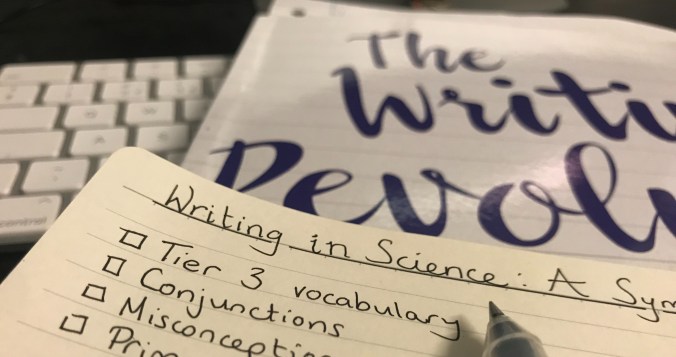
Starting with this premise, I am excited to introduce a series of blog posts, written by a range of science teachers, that focus on writing in science: ‘Writing in Science: A Symposium’. Why have a series of blogs on writing, and why explicitly narrow it to science teaching?
To answer the second part of the question first, science is a subject discipline which demands a specific type of writing. Firstly, it requires the masterful use of domain-specific (tier 3) vocabulary. Often these words have homonyms which range from having wholly different meanings (e.g. tissue, field) to subtly different shades of meaning (intensity, diffuse). This difficulty is compounded when these words are associated with misconceptions. Secondly, the discipline is unique in that scientific ideas have great explanatory and predictive power. Consequently, science writing demands the ability to distinguish between the generic (referring to principles and theories) and the specific (manifestations and examples), as well as the ability to differentiate between observation/description and explanation – to name a few dimensions of science writing.
To answer the first part of the question, my experiences dictate that the explicit teaching of writing in science is often wrongly neglected. Science departments may flirt with the idea of teaching writing, when they embed literacy activities and emphasise key words in their lessons, but these can be superficial, surface-level pedagogies which fail to make significant impact on pupils’ science-writing abilities. To embrace the teaching of writing in science would be to systematically weave clear, whole-hearted writing activities into the core of the curriculum, with carefully sequenced activities that guide pupils step-by-step towards the expression of both complex scientific phenomena and apparently everyday observations. Clear, concise and unambiguous communication in science is as important an outcome of an excellent science education as is the knowledge of scientific phenomena itself.
So, if we can establish that teaching writing in science is both valuable and useful, it becomes our duty to then identify what the best strategies for teaching writing in science are, and how to integrate them within the curriculum. This symposium is a platform for everyday teachers to share the ideas they have been trialling to teach writing explicitly in their science lessons. Whilst we are not researchers or ‘experts’, we are seeking to explore and understand what good practice in this area could look like, and interrogate the gaps in our knowledge.
The problem we all started with is that there is very little accessible work reaching us, that tells us how to achieve these aims. Most of us have come across ideas on short-term literacy activities in science (things like writing frames), but very little on how to systematically improve writing through the science curriculum over the long-term. As teachers in the classroom, we want answers to the following questions:
- Is it worth our time to think deeply about writing in science: will the effort yield the outcomes we desire?
- If it is worth our time, what sorts of things work?
- Can an explicit focus on writing actually help our pupils with their conceptual understanding of science?
A significant challenge to the explicit teaching of writing in science, other than the obvious – sufficient time for deliberate practice – is that it is seemingly disincentivised by GCSE specifications. The most challenging writing expected of pupils at this stage can be found in the 6-mark questions. Pupils can be awarded full marks by referring to the key points in a logical sequence. Full sentences and scientific nuance are not necessary. Arguably, this signals that being able to construct clear scientific sentences and paragraphs is of secondary importance.
Yet the power of writing holds great promise because I believe a focus on writing will serve to better teach scientific concepts in the first place. The reason I think this? Many of the blog posts in this symposium take inspiration from the excellent book, The Writing Revolution, by Judith C. Hochman and Natalie Wexler. The book explains the rationale behind explicitly teaching writing through our subjects and shares lots of well-designed activities. Each activity involves the deliberate practice of writing strategies with a focus on clauses, conjunctions and sentence-level tasks.
The Writing Revolution argues that writing is a tool for thinking, as much as it is a means of expressing knowledge. By focusing on conjunctions, you can help pupils understand sequences and relationships between ideas such as cause-and-effect. By focussing on crafting sentences from fragments and building up to complex sentences, we can give pupils the opportunity to practice declarative knowledge in a way that improves their writing and science knowledge simultaneously. What could emerge, then, from the explicit teaching and deliberate practice of content and writing together, is an understanding of the science that has a superior clarity compared to having just taught content on its own. Furthermore, as pupils come to recognise and be able to manipulate syntax, they should become better readers, comprehending challenging academic texts. This equips them with the tools to become masters of their own scientific learning – surely the aim of all educators? Finally, preparing pupils to write scientifically is to set up them up well for future pursuits in the sciences.
These blogs hope to use both ideas from this book and ideas of our own to reflect on the extent to which we think writing can be useful in science, and share both theoretical thinking and practical advice on this topic.
- Ben Rogers kicks off the symposium by exploring the teaching of tier 3 vocabulary in Science – the building blocks of a good scientific sentence.
- Ruth Walker moves this forward by explaining how teaching pupils to use conjunctions can help them better grasp and practice scientific knowledge.
- Tarjinder Gill discusses strategies she uses to develop her pupils’ writing in primary science.
- Jasper Green looks at the extent to which revealing and tackling misconceptions through writing is possible: could opportunities to write longer answers provide the opportunity to reveal misconceptions?
- I am also extremely excited to announce, that I got in touch with Judith Hochman – and Natalie Wexler – the authors of The Writing Revolution – and they have very kindly written a concluding post to this symposium!
I hope to add to this series in the future as we and others continue to find out what works and what doesn’t. Do get in touch if you wish to contribute.
P.S. On Twitter, you can use the hashtag #WritingInScience to find the posts, comment and share ideas. Science teachers can also follow #CogSciSci for posts on applying cognitive science to science education.
 Bunsen Blue
Pingback: Characteristics of Science Vocabulary and Some Classroom Tools – Reading for Learning
Pingback: Sentences and the web of knowledge
Pingback: @teacherhead Update #1. October ’18. | teacherhead
Reblogged this on The Echo Chamber.
LikeLike
Pingback: Applying Cognitive Load Theory to English Part 4: Combining The Alternation Strategy and The Problem Completion Effect-Examples from teaching writing. – TomNeedham
Pingback: Writing Revolution Activities in Primary Science – Teachwell
Pingback: Writing in Science: Guest post by Hochman and Wexler | Bunsen Blue
Pingback: Writing in Science – teachingandlearningblog
Pingback: Transforming Science Lessons with Habits of Discussion and The Writing Revolution – Mr. G Mpls
Pingback: Incorporating Deliberate Practice Into Science Lessons with Habits of Discussion and The Writing Revolution – Mr. G Mpls
Pingback: The six best blogs I’ve read this year – A Chemical Orthodoxy
Pingback: #CogSciSci 2019 to do list – Catalysing Learning
Pingback: EEF Science Guidance Links – Kaye Chem Notebook
Pingback: Writing in science: a symposium (blog, – teachingandlearningblog
Pingback: Is cognitive science destined to mutate? – A Common Biologist
Pingback: The best list of research links – brilliant! | Kesgrave High School
Pingback: How do my students practise things they “just need to know”? – CogSciSci
Pingback: Supporting Secondary School Literacy